Using Fund Volatility to Help in Selecting Funds
Understanding fund volatility can help investors identify appropriate funds that best fit their investment goals and risk appetites. This may easily be done by comparing the performances of various funds using Lipper's Fund Volatility Factor (FVF) and Fund Volatility Classification (FVC).
The selection of unit trust funds should be evaluated not only on their returns over time but also the volatility (or risk) of those returns. Unit trust investors should be aware of the risk category of the funds which they have invested in as well as that of other funds which are available in the market.
By understanding how volatility can impact investment outcomes, unit trust investors can select funds that are most suited to their risk profiles and investment objectives. Knowing the potential volatility of funds will also better align investors’ expectations with the actual performance of their investments.
In the Malaysian private unit trust industry, the Federation of Investment Managers Malaysia (FIMM), in collaboration with international fund ranking provider, Lipper, offers a measure of a fund’s risk factor (Fund Volatility Factor) and a risk classification (Fund Volatility Classification) for unit trust management companies to assist investors in the latter’s fund selection process.
Fund Volatility Factor (FVF)
The Fund Volatility Factor (FVF), in statistical terms, is the annualised standard deviation of a fund’s returns. This variable allows investors to measure the volatility of the fund’s returns relative to its average return over a three-year period. A fund will have a higher FVF if its returns fluctuate widely against its average return, while registering a lower FVF if its returns are less volatile around the average return.
The FVFs for all unit trust funds with track records of at least three (3) years are computed by Lipper on a monthly basis.
Fund Volatility Classification (FVC)
Meanwhile, the Fund Volatility Classification (FVC) ranks all qualified unit trust funds by their volatility level. Funds under the lowest quintile (or lowest 20 percent) of the FVC are categorised in the ‘Very Low’ volatility category and these funds are classified as having the lowest volatility of returns. This is followed by funds in the following FVC categories, with an ascending level of return volatility; namely ‘Low’, ‘Moderate’, ‘High’ and ‘Very High’. The FVC is usually revised every six months or at shorter time intervals as advised by FIMM and Lipper.
Figure 1: Example of FVF and FVC Disclosure in an Icon
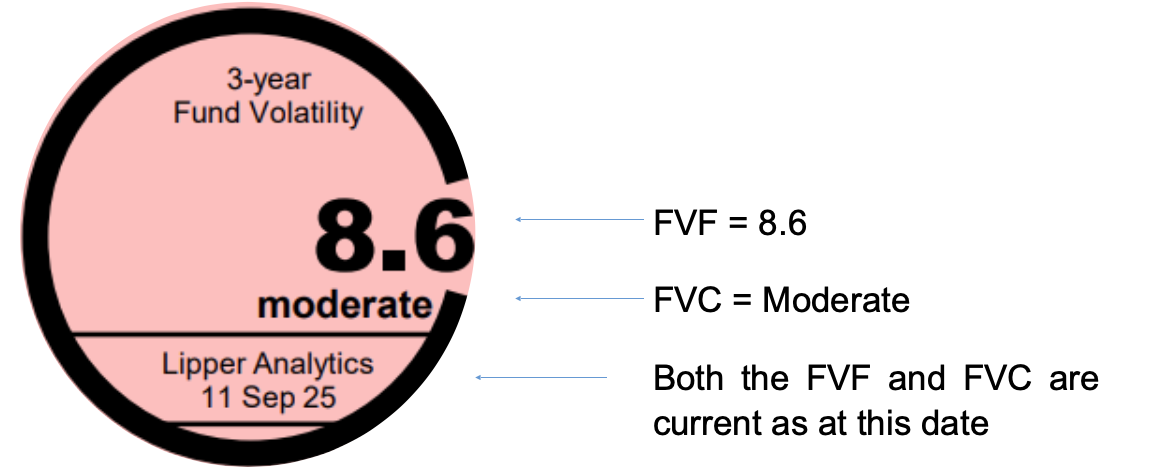
Understanding fund volatility is important as it guides unit trust investors in determining the risk-reward parameters of their investments and picking funds that fit their risk profiles. Both the FVF and FVC provide a guide for investors to gauge the potential volatility of returns of a particular fund based on the fund’s returns in the recent past. As the fund volatility measures how much a fund’s returns can fluctuate (around its average returns), it enables investors to assess whether a particular fund is suited to their risk tolerance.
The FVF and FVC for Public Mutual’s unit trust funds are available in the Monthly Fund Review report, which can be accessed by investors through Public Mutual Online (PMO).
Using FVF and FVC
Table 1: Fund Volatility Classification (FVC) and Bands for Lipper’s Fund Volatility Factor (FVF)
FVC |
Volatility Band (FVF)* |
Very Low |
0.0 ≤ FVF ≤ 4.330 |
Low |
4.330 < FVF ≤ 8.095 |
Moderate |
8.095 < FVF ≤ 10.695 |
High |
10.695 < FVF ≤ 14.435 |
Very High |
FVF > 14.435 |
Table 1 shows the FVC of funds categorised based on their respective FVF volatility band as at 30 September 2025. Based on Lipper’s classification, funds with an FVF of 4.330 and below are classified under the ‘Very Low’ FVC category, whilst the ‘Low’ FVC category consists of funds with an FVF of above 4.330 up to 8.095. Meanwhile, the ‘Moderate’ FVC category has an FVF of over 8.095 up to 10.695. Funds with an FVF of above 10.695 up to 14.435 have an FVC category of ‘High’, whilst the ‘Very High’ FVC category consists of funds with an FVF of above 14.435.
The figure below shows the FVC for various categories of Public Mutual’s funds.
Figure 2: FVC for Various Categories of Public Mutual’s Funds*
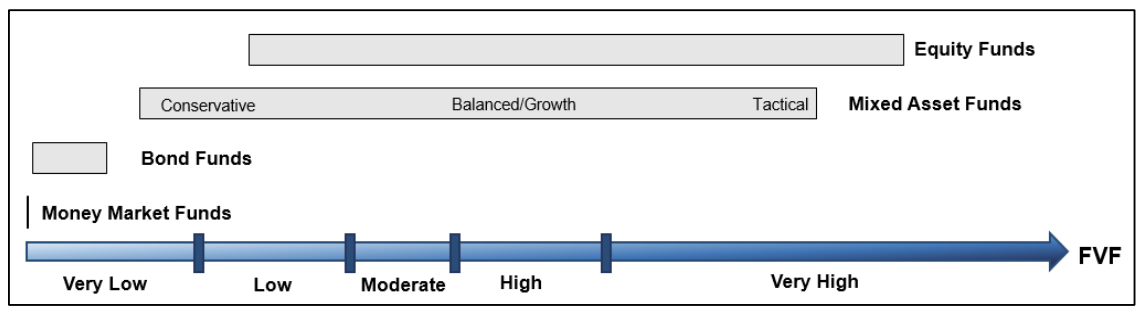
* Based on the FVF of Public Mutual’s unit trust funds as at 30 September 2025
Public Mutual’s money market funds have a ‘Very Low’ FVC as the funds are mostly invested in deposits, money market instruments and/or short-tenured fixed income securities which do not experience significant fluctuations in value. Therefore, the money market funds are suitable for investors who require price stability and capital preservation.
Our bond funds generally have ‘Very Low’ FVC. Investors with a conservative risk profile who require regular income may find bond funds suitable for their investment objectives.
The FVC classification of our mixed asset funds may range from ‘Very Low’ to ‘Very High’, depending on the weightage and volatility of the individual funds’ underlying assets.
As shown in Figure 2, the mixed asset category comprises funds with a wide volatility range. Mixed asset conservative funds, which may invest up to 35% of their net asset value (NAV) in equities are positioned at the lower end of the volatility range. This is followed by balanced funds and mixed asset growth funds, which invest up to 60% to 70% of their NAVs in equities respectively. At the higher end of the volatility range, tactical funds, which can invest up to 98% of their NAV in equities, tend to register higher volatility of returns.
Meanwhile, our equity funds may have FVCs ranging from ‘Low’ to ‘Very High’. For example, equity funds which are focused on small-cap stocks tend to be more volatile than those that are focused on dividend-yielding stocks. Equity funds that focus their investments in foreign markets which have higher volatility of returns compared to Bursa Malaysia will generally register higher FVCs compared to domestic equity funds.
Investors with an aggressive risk tolerance (i.e. who are able to withstand higher levels of volatility) may select funds with ‘High’ and ‘Very High’ FVCs. These funds can potentially deliver higher returns, but are also subject to correspondingly higher levels of volatility in their returns.
Conclusion
To sum up, a fund’s volatility factor and risk classification can provide investors with information on a fund’s risk profile and help investors make better investment decisions. However, it is worth noting that fund volatility factors will not predict a fund’s future performance as past performance is not an indication of future performance.
When selecting funds in the various fund categories, investors can consider the potential risk of the funds, as measured by Lipper’s FVF and FVC indicators, whilst remaining focused on their long-term investment objectives and risk profiles.
This article is prepared solely for educational and awareness purposes and should not be construed as an offer or a solicitation of an offer to purchase or subscribe to products offered by Public Mutual. No representation or warranty is made by Public Mutual, nor is there acceptance of any responsibility or liability as to the accuracy, completeness or correctness of the information contained herein.